

EV Charger Installation in Northern Virginia
Charging an electric vehicle at home is a lot more convenient than relying on public stations, but the outlet in your garage probably isn't built for it. Most EV owners quickly outgrow a standard household outlet, which is why EV charger installation usually means adding a dedicated circuit, and often a panel upgrade, to charge at a speed that actually fits their daily driving.
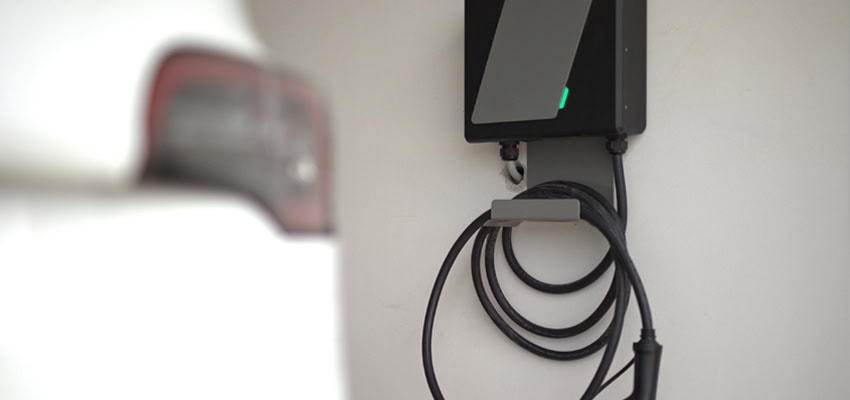
Nichols & Phipps installs home EV charging equipment across Northern Virginia, and we handle the electrical work behind it: circuit sizing, panel capacity, permits and the final connection.
Level 1 vs. Level 2 Charging
Level 1 charging uses a standard 120-volt outlet, the same kind of outlet already in most garages. It works, but it's slow, often adding only a few miles of range per hour. For most drivers, that's not enough to reliably charge overnight.
Level 2 charging runs on a 240-volt circuit, similar to what powers a clothes dryer or an electric range. It charges several times faster than Level 1 and is what most EV owners end up wanting once they see how long a full charge actually takes on a standard outlet.
The Panel Capacity Question
Before we talk about the charger itself, we need to know whether your electrical panel has room for it. This is the part of the job that catches homeowners off guard.
Older homes, especially those with 100-amp panels, often don't have the spare capacity for a Level 2 charger on top of everything else already running in the house. Adding one without checking capacity first can overload the panel. In many cases, the real cost of an EV charger installation isn't the charger. It's the panel upgrade that has to happen first to support it safely.
We check your panel's capacity before we recommend anything, so you know upfront whether you're looking at a straightforward install or a panel upgrade as part of the job.
Hardwired vs. Plug-In Chargers
Home EV chargers come in two connection types. A hardwired charger is wired directly into your electrical system with no plug involved, which some manufacturers require to maintain their warranty. A plug-in charger connects to a dedicated outlet, which makes it easier to move or replace later. Which one makes sense for your home depends on the charger you choose, where you want it mounted, and local permit requirements.
Garage, Driveway & Detached Garage Installations
Where you park determines how the job gets wired. A charger mounted in an attached garage is usually the simplest run, since the panel is often close by. A driveway-mounted charger for homes without a garage, or a charger for a detached garage set back from the house, both require running conduit and wiring further, which affects labor and materials. We'll walk your property with you before quoting the job so there aren't surprises once work starts.
Permits and Inspection in Northern Virginia
EV charger installations typically require an electrical permit and inspection in Northern Virginia jurisdictions. Requirements vary by county, and we handle the permitting process as part of the installation so you don't have to sort it out yourself.
What Affects the Cost of EV Charger Installation
Every install is a little different, and the cost depends on a few things:
- Whether your panel has room for a Level 2 charger, or needs a panel upgrade first
- The distance between your panel and where the charger will be mounted
- Whether the charger goes in an attached garage, a driveway or a detached garage
- Hardwired versus plug-in installation
We'll give you a clear number for your specific setup before any work begins.
Call Nichols & Phipps for EV Charger Installation
If you're ready to charge at home instead of hunting for a public station, we can evaluate your panel and get you set up with a Level 2 charger built for how you actually drive. We offer 24-hour emergency service and also handle electrical repair and new service if there's other work to do while we're there. Serving Fairfax, Prince William, Loudoun, Arlington, Fauquier and Stafford counties, plus Alexandria, Manassas and Falls Church. Call (703) 670-8519 or request an appointment online.
-
Call: (703) 670-8519
View Special Offers & Coupons
Why Nichols & Phipps for Electrical?
- Up-Front Pricing
- No Sneaky Upgrades or Dishonest Tactics
- 24-Hour Emergency Service
- Financing Available with Approved Credit
- Accurate Proposals
- Repair & Replace All Makes and Models