


How Water Quality Affects Your Plumbing
When a pipe fails, most homeowners blame the pipe. In reality, the water running through it is usually the bigger factor. Well water vs city water is one of the most overlooked variables in how long copper, PEX and CPVC plumbing actually last, and understanding the difference can save you from replacing a pipe that was never really the problem in the first place.
At Nichols & Phipps, we’ve serviced homes across Fairfax, Prince William, Loudoun and the surrounding areas since 1972, on both municipal water and private wells. What we’ve learned over the decades is simple. The pipe matters, but the water decides how that pipe ages.
What’s Actually in Your Water
Every water source carries something, whether it’s minerals, treatment chemicals, or acidity that most homeowners never think to test for. A few of the most common factors that affect plumbing, regardless of where your water comes from, include the following:
- Hardness, from calcium and magnesium, that builds scale inside pipes, fixtures, and water heaters
- Low pH, or acidic water, that can corrode metal components over time
- Iron and manganese that stain fixtures, discolor laundry, and clog aerators
- Chlorine or chloramines, added for disinfection, that interact differently with different pipe materials
- Sediment that wears down valves and moving parts
Which of these show up, and how much of each, depends largely on whether your water comes from a municipal system or your own well. That’s the real dividing line, not the pipe itself.
How City Water Affects Your Plumbing
If your home is on Fairfax Water, Prince William Water, Loudoun Water, or the City of Manassas system, your water has already been treated and disinfected before it reaches your house. That treatment keeps the water safe, but the disinfectant itself, usually chlorine or chloramines, is something your plumbing has to contend with over the long term.
A few signs point to specific city water issues worth knowing about:
- Brittle or cracking CPVC, especially on hot water lines in older homes, is usually a sign of years of heat and installation stress rather than chlorine itself
- A chlorine smell coming from CPVC pipe, more common in homes with higher chlorine levels
- A pipe that won’t hold a clean cut during a repair, often a sign the CPVC has become brittle with age
- Scale buildup on fixtures or inside water heaters, even with copper pipe, is usually a sign of hardness rather than corrosion
Of the common residential pipe materials, CPVC holds up the best against chlorine, and that’s by design. Chlorine is part of its chemical makeup, giving it a natural resistance that copper and PEX don’t have. If you’re repiping specifically because of chlorine-related damage, CPVC is worth discussing with your plumber for that reason.
That said, in our experience, heat and installation stress are what actually take CPVC out, not chlorine directly. We’ve seen pipe coming off a water heater so brittle we couldn’t make a clean cut without it cracking further, which sometimes means opening drywall just to reach material solid enough to form a reliable joint.
Copper and PEX are both common on municipal water throughout our service area, and both generally hold up fine under normal disinfectant levels.
Why Water Testing Matters More Than the Pipe Material
This is the part homeowners tend to skip, and it’s the part that actually determines whether a repipe solves the problem or just delays it.
Imagine a home with repeated copper pinhole leaks. The homeowner replaces the leaking section, and a few years later, another leak develops somewhere else. Then another. Each time, the instinct is to replace more copper, but if the water itself is acidic, new copper will fail the same way the old copper did. The pipe was never the actual problem.
Testing gives you the missing half of the story. A leak tells you where something failed. A water test tells you why, whether that’s pH, hardness, iron, or something else entirely, and it’s the information that actually determines the right long-term fix, whether that’s a different pipe material, a water treatment system, or both.
Here’s what that looks like in practice.
House 1, stable municipal water
- Normal pH, moderate hardness, no history of corrosion
- Copper, PEX, and CPVC are all reasonable choices
- The decision comes down to budget, installation, and personal preference
House 2, acidic well water
- Low pH, repeated copper pinhole leaks
- Installing new copper without addressing the water chemistry means the same failure happens again
- The right fix may be a water treatment system, a non-metallic pipe like PEX or CPVC, or both
Same list of materials, two completely different answers, because the water is different.
If you’re on a private well, the EPA recommends testing at least annually for total coliform bacteria, nitrates, total dissolved solids, and pH. If you’re seeing staining, corrosion, or repeated leaks, a more detailed test covering hardness, alkalinity, and iron will tell you more. If you’re on municipal water, your provider publishes an annual water quality report, and it’s worth a look, especially if you’re planning a repipe or noticing new plumbing issues.
Copper, PEX & CPVC at a Glance
None of these materials are simply good or bad for well water or city water. Each responds differently depending on the specific water chemistry involved.
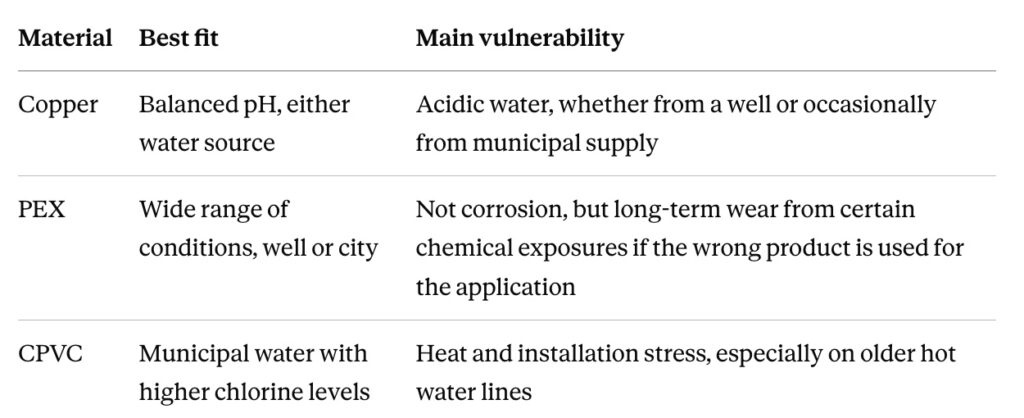
A quick note on PEX. You may come across PEX-A and PEX-B in your research, which refer to two different manufacturing processes rather than two different products. PEX-A is more flexible, holds up a bit better in freezing temperatures, and uses expansion-style fittings, while PEX-B is slightly stiffer, uses crimp or clamp fittings, and typically costs less to install. For most homeowners, that distinction matters less than whether the specific product is rated for your water conditions and installed correctly, but it’s worth knowing the difference exists before your plumber recommends one over the other.
The right material for your home depends less on whether you’re on a well or on city water and more on what your water test shows, along with the age and condition of your existing plumbing.
Should You Repipe OR Treat the Water First?
Not every plumbing problem calls for new pipe. If your existing plumbing has been performing well for years, well water or city water alone isn’t a reason to replace it. If you’re dealing with repeated leaks, staining, or corrosion, the better first step is usually figuring out why, through testing, before deciding what to replace it with.
Sometimes the fix is a water treatment system, like an acid neutralizer for low pH well water or an iron filter for staining, rather than a different pipe material. Sometimes it’s both. The right answer depends on what the test actually shows, not on a general rule about wells versus municipal water.
Whether your home runs on well water or city water, we can help you figure out what your plumbing is actually dealing with, and what it needs going forward. Call us today at (703) 670-8519 or schedule a plumbing evaluation, so you know what your water is doing to your pipes before you decide what to do about it.
Frequently Asked Questions
Does well water damage copper pipes more than city water?
It can, mainly because well water hasn’t been treated or pH-balanced before reaching your plumbing. Acidic well water commonly causes copper pinhole leaks and blue or green staining around fixtures. City water is treated to keep pH in a safer range, which generally makes it less aggressive toward copper.
Is PEX a better choice than copper for well water?
PEX doesn’t corrode the way copper can, which makes it a solid option for acidic well water. That said, the right choice still depends on your specific water test and what you’re trying to solve, not simply the fact that you’re on a well.
What’s the difference between PEX-A and PEX-B?
Both are cross-linked polyethylene pipe, but they’re manufactured differently. PEX-A is made using a process that cross-links the material more fully, which makes it more flexible, better suited to freezing temperatures, and repairable with a heat gun if it kinks. It uses expansion-style fittings and generally costs more. PEX-B is made with a different process that results in a slightly stiffer pipe, uses crimp or clamp fittings, and is typically less expensive to install. Neither is automatically the better choice for well water or city water. The right one depends on your water conditions, your installer’s preferred fitting system, and your budget.
Does CPVC corrode like copper?
No. CPVC is a plastic pipe and doesn’t experience the metal corrosion that affects copper. Its main weak points are heat and installation stress over time, not water chemistry, which is different from what typically causes copper to fail.
Does hard water damage my pipes?
Hardness is more often a fixture and appliance problem than a pipe problem. Scale from calcium and magnesium can build up on faucets, showerheads, and inside water heaters, but it’s rarely the reason a pipe itself fails. If you’re noticing heavy scale, a water softener is usually a more direct fix than a different pipe material.
Does chlorine in city water damage plumbing?
t can, depending on the material and how long the water sits in the pipe. CPVC is specifically designed to resist chlorine. Copper and PEX generally hold up well under normal municipal disinfectant levels, but very old plumbing or unusual water chemistry may still warrant a professional look. Want to know more? We went into detail here.
Should I replace copper with PEX if I have well water?
Not automatically. If your copper plumbing has been performing well for years, there’s no need to replace it just because your home is on a well. If you’ve had repeated leaks, staining, or corrosion, that’s a better reason to test your water and discuss your options with a plumber.
What should I test my well water for?
At minimum, the EPA recommends annual testing for total coliform bacteria, nitrates, total dissolved solids and pH. If you’re seeing staining, corrosion, or repeated leaks, a more detailed test covering hardness, alkalinity, and iron is worth the extra step.
How do I know if my water, not my pipe, is the real problem?
Repeated leaks in the same area, staining around fixtures, or a new leak shortly after a repair are all signs worth a second look. A professional evaluation can tell you whether the material, the water, or the installation is behind the pattern.
What’s the best pipe material for well water or city water?
There isn’t one universal answer for either. Copper, PEX, and CPVC can all be good choices on a well or on municipal water, depending on the specific water chemistry, the age of the system, and how the pipe is installed. Well water isn’t automatically bad, and city water isn’t automatically ideal. It comes down to what your water is actually doing to your plumbing.