



The Honest Guide to Making the Right Call
The HVAC repair or replace decision is one of the most common questions we hear at Nichols & Phipps, and it’s a fair one. A new system is a significant investment. So is pouring money into one that keeps breaking down.
The honest answer is that there’s no single rule that works for every situation. But there is a framework we use on every service call that takes the guesswork out of it, and we want to share it with you.
Why This Decision Got More Complicated
A few years ago, the repair-or-replace conversation was simpler. Age and repair cost were really the only factors that mattered. But refrigerant changes over the last several years have added something new to the equation that most homeowners don’t know about yet.
Every HVAC system runs on a refrigerant, the chemical that actually makes the cooling process work. Think of it like the blood in your system’s circulatory system. When there’s a leak, the whole system struggles. And here’s the part most people are surprised to learn: refrigerant is not a consumable. It doesn’t wear down or get used up over time. In a properly functioning system, it circulates indefinitely. So if a technician ever tells you that your refrigerant is low, that means you have a leak, full stop.
Why does this matter? Because the type of refrigerant your system uses affects how much repairs might cost you in the future, and whether those repairs are even worth making.
The Refrigerants You’ll Encounter
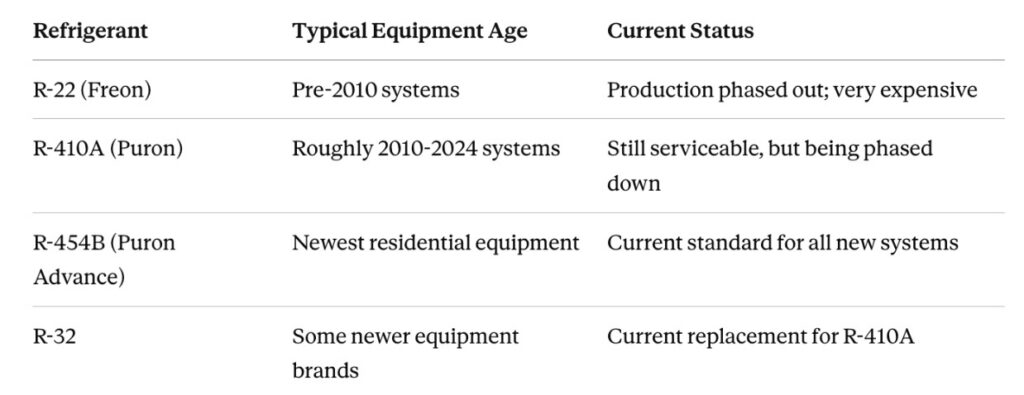
The important thing to know is that you should never assume what refrigerant your system uses based on age alone, because there was overlap during the transition years between refrigerants. The right way to find out is to look at the manufacturer’s data plate on your outdoor unit. It will show the refrigerant type, the factory charge, and the model and serial number. That label is your starting point for any repair-or-replace conversation.
Our General Rules by Refrigerant Type
If Your System Uses R-22
In most cases, we’re going to recommend replacement rather than a major repair. R-22 production has been banned entirely, which means the refrigerant itself is now very expensive to source. Compressor failures, evaporator coil replacements, and refrigerant leaks on R-22 systems rarely make financial sense to repair. There are occasional exceptions for small repairs when the rest of the system is in good shape, but those situations are uncommon.
If Your System Uses R-410A
This is where we push back against a trend we’re seeing in the industry. Some companies will tell you that because R-410A is being phased down, you should replace your system. We disagree with that as a blanket recommendation.
A well-maintained R-410A system installed in 2018 may be a significantly better financial decision to repair than replacing it with a brand-new system today. R-410A systems are still fully serviceable, parts are available, and technicians know them well.
We recommend repair if:
- The system is under 12 to 15 years old
- The compressor is healthy
- The repair cost is less than about 30 to 40 percent of what a replacement would cost
Don’t replace a working R-410A system just because of the refrigerant. The refrigerant alone is not a reason.
If Your System Uses R-454B or R-32
You have the most current refrigerant technology. These systems are good candidates for repair and ongoing maintenance throughout their expected lifespan. Equipment and technician familiarity with these systems will continue to improve as they become more common.
The Quick Decision Guide We Use in the Field
Here’s how we think through it in real terms:
An 8-year-old R-410A system with a failed capacitor or contactor? Repair it. That’s an inexpensive fix on a system with years of life left.
A 12-year-old R-410A system that needs a compressor? We sit down with the homeowner and look at the numbers carefully. It might go either way depending on the overall condition of the system.
A 20-year-old R-22 system that needs a compressor and refrigerant? Replace it. The math doesn’t work out in favor of repair.
What We Actually Look At
When we evaluate a system, refrigerant is just one piece of the picture. We also look at:
- Age of the equipment
- Leak history
- Compressor condition
- Heat exchanger condition if there’s a furnace involved
- SEER rating and efficiency
- Cost of repair versus cost of replacement
- How long the homeowner plans to stay in the property
Every one of those factors matters. Refrigerant alone doesn’t tell the whole story, and neither does age. A good assessment requires looking at everything together.
Why We Tell You This
We don’t work on commissions at Nichols & Phipps. That means we have no financial incentive to push you toward a replacement when a repair is the right call, or to recommend a band-aid repair when a replacement would serve you better. Our goal is to give you the honest picture so you can make a decision that actually makes sense for your situation.
When it’s broken, we fix it. When it’s unfixable, we replace it. When it’s working, we keep it that way.
If you’re weighing a repair quote right now or just want a second opinion on what someone else has told you, give us a call at (703) 670-8519 or schedule online. We’re happy to take a look and give you a straight answer.